Transformers
1. Working principle of single-phase transformer
So, a transformer's Most basic working principle is a Concept Called "Mutual Induction". In this blog, we will see more about it.
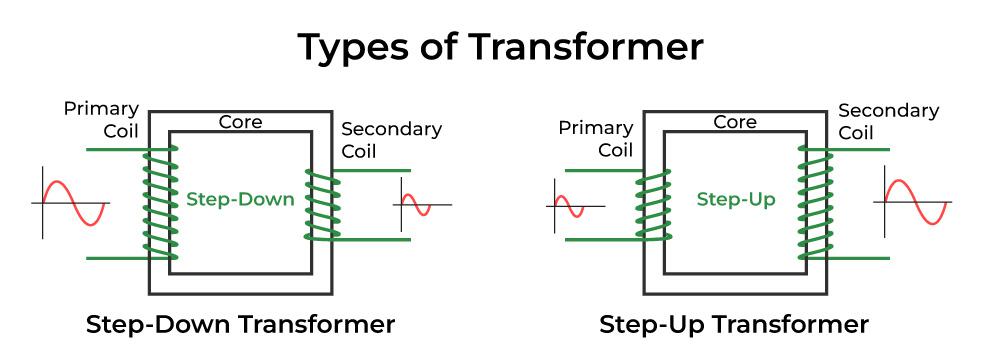
1) Core: A Core is a component where the Windings of transformers are Installed. Core Comes in various Variations, If given that it is Iron Core or So but if no core is shown it is assumed to be "Air Core". Cores are usually thin laminated Metal sheets it is done to avoid the Generation of Eddy Currents.
2) Windings: Windings are the Wires Winded on the core they have two Variation
a) Primary Winding: Primary Windings are also termed as Input Terminal from which a Desired Current id Fed. The number of Turns depends on the type of transformer Step-Up or Step-Down.
b)Secondary Winding: Secondary Winding is also termed an Output Terminal from which a Desired Current is Obtained. The number of Turns depends on the type of transformer Step-Up or Step-Down.
3) Types Of Transformer:
a) Step-Up: Whenever we need to Increase the Current/Voltage we Use a step-up Transformer. In this type of transformer Number Of Winding In the Primary < Number Of Winding In the Secondary Coil.
b)Step-Down: Whenever we need to Decrease the Current/Voltage we Use a step-down Transformer. In this type of transformer Number Of Winding In the Primary > the Number Of Winding In the Secondary Coil
2. EMF Equation of a Transformer
Sinusoidal Alternating Voltage is applied to the Primary winding. This processes the flux in the core, which also varies sinusoidally. Let the equation of Sinusoidal alternating flux in the core be :
\( \Phi = \Phi_{m}\sin(\omega t) \) --- Eqn 1
According to Faraday's law of electromagnetic induction, the self-induced EMF in Primary Winding is given by
\( e_{1} = -N_{1} \frac{d\Phi}{dt} \)= \( -N_{1}\Phi_{m}\sin(\omega t) = -N\Phi_{m}\cos(\omega t) \)
--- from Eqn 13. Losses in a Transformer
What is Loss in a transformer ???
The Difference between the Input and Output Current/Voltage is Known as Loss. There are Several Types of Losses in a Transformer.
a) Core Loss (Iron Loss) (Constant Loss) -
i) Eddy Losses - When a single block of Iron is Used in the Core it produces an eddy current loss, Hence core is made up of laminated thin Metal sheets.
ii) Hysteresis Losses - Whenever an EMF is Induced to the Core A Magnetic Field is Generated. As input is Alternating it keeps Magnetizing-Demagnetizing the core several times which leads to the heating of the core and Hysterisis loss
b) Copper Loss (Variable Loss) -
It occurs in the winding of Transformers. As every conductor has its own Resistance. As Windings are made up of Copper due to all of this resistance they get heated up due to which much of its energy is lost in the form of Heat.
4. Actual(Practical) and Ideal Transformer
a) Ideal Transformer
i) Primary and Secondary Windings have Zero Resistance.
ii) There is No leakage of Flux. ie same no.of Flux Passes through Primary and Secondary Winding.
iii) The permeability of the Core is assumed to be infinite.
iv) No Copper loss in Windings.
v) There is No Iron Loss in Windings.
vi) Efficiency is 100%
vii) Ideal Transformer is used only For Analysis purposes.
a) Actual (Practical) Transformer
i) Primary and Secondary Windings have a Resistance.
ii) There is leakage of Flux. ie same no. of Flux Passes does not through Primary and Secondary Winding.
iii) The permeability of the Core is assumed to be finite.
iv) Copper loss in Windings.
v) There is Iron Loss in Windings.
vi) Efficiency is <100%
vii) A Practical Transformer is used For Practical uses.
5. Formulae & Numericals
1) \( \text{KVA Rating} = \frac{E_{1}I_{1}}{1000} \) \( \text = \frac{E_{2}I_{2}}{1000} \) --- Full Load
\( I_{1} = \frac{\text{KVA Rating} \times 1000}{E_{1}} \)
\( I_{2} = \frac{\text{KVA Rating} \times 1000}{E_{2}} \)
2) Transformation Ratio
\(\frac{{E_1}}{{E_2}} = \frac{{N_1}}{{N_2}}\)
Numerical
Q) A 80 KVA, 3200/400v, single phase, 50 Hz transformer has 111 turns on the
secondary windings. Calculate. a) no. turns on primary. b) Secondary full load current
c)Cross Sectional area of core if the maximum flux density is 1.2 Tesla
Soln :
a) Transformation Ratio
\(\frac{{E_1}}{{E_2}} = \frac{{N_1}}{{N_2}}\)
Hence \(\frac{{3200}}{{400}} = \frac{{N_1}}{{111}}\)
Therefore \(N_1\) = 888 Turns
b) \( I_{2} = \frac{\text{KVA Rating} \times 1000}{E_{2}} \)
\( I_{2} = \frac{\text{80} \times 1000}{400} \)
Therefore \(I_2\) = 200 Amps
c) Φ = 1.2 --- Given
\( E_{2} = 4.44fN_{2}\Phi_{m}V \)
\(4.44 \times fN_{1}B_{m}AV\) --- \( \Phi_{m} = B_{m}A \)
∴ 400= 4.44(50)(111)(1.2)xA
∴ \( A = \frac{400}{4.44 \times (50) \times (111) \times (1.2)} \)
∴ \( A = 0.0135m^2 \)
Comments
Post a Comment